
My Deepest Fear
/
Would my illness be as serious today if I had gotten treated younger, if I had entered therapy sooner, if I had learned coping strategies earlier?
Read MoreWould my illness be as serious today if I had gotten treated younger, if I had entered therapy sooner, if I had learned coping strategies earlier?
Read MoreImagine if I lose a leg, and my friend kicks my stump in the middle of a conversation. I would be indignant, and he would no longer be my friend. My friends, family, and coworkers do not know if some off-hand comment will kick my invisible stump. We tiptoe around mental illness because we do not know if what we say will cause more damage. That is the unique dilemma of mental illness compared to physical illness.
Read MoreIn my free time, I will be exploring more about Stoic philosophy, and how it can be applied to modern living and my permanent recovery from mental illness.
For my blog, each Wednesday I will share some of my whiteboard, and we’ll see if we make any discoveries, together.
Read MoreI invite you to adopt a depressed mindset, and examine something or someone that bothers you. Then step back, squint, refocus, and see if you can find a more nuanced perspective. You will realize that this black and white thinking is a complete crock.
Read MoreThese are moments where you can take a breath and take stock of your situation. In games, these are built into the experience - timeouts, quarter breaks, halftime, weather delays. Pause points exist in daily life, but it takes work to identify ones that are meaningful to you.
Read MoreThe smartphone is the fire of our generation, but if we do not set some limits; we will inevitably burn ourselves.
Read MoreTravel used to be a big deal. We must remember that while we live in a more technologically advanced society; our bodies have yet to adapt to what is commonplace for most people in developed nations.
Read More
Mondays and Thursdays are my best days, but Tuesdays afternoons and Saturday evenings are difficult for me.
February and March are when I feel the very best, but I tend to slip into a mild depression at the end of the lacrosse season in May.
I am more productive in the summer, but I am usually affected by Seasonal Affective Disorder, SAD, in the late fall.
How do I know all this? I tracked my mood twice a day for two years with an app, iMoodJournal. Every week, I reviewed the data and noted low and high days. Then I recalled what happened on those days, and, very slowly, the bigger picture revealed itself to me.
Before I tracked my mood, I assumed that my depressive episodes were sporadic and random. Because of that, I further assumed that they were beyond my control. I felt trapped in a mental “fog of war,” a term that means, “uncertainty regarding one's own capability, adversary capability, and adversary intent during an engagement, operation, or campaign.”

“Can anyone see the enemy?”
It is terrifying, stumbling around in the dark; knowing an enemy lurks nearby. It is even more terrifying when the enemy is your own mind.
After my hospitalization in the fall of 2016, I decided to map my mind as well as I could. iMoodJournal and PocketCBT were tools I used to spy on my internal enemy that was intent on doing me harm.
By identifying the times when depression or anxiety were most likely to launch an assault; I had time to dig a mental foxhole.
I could gather supplies and call in reinforcements. All of this gave me the mental ability to say to my depression and anxiety:
I do not win every battle, but I no longer feel like I’m losing the war. There is immense psychological relief that comes from preparation. Whether that is rehearsing a presentation, doing breathing exercises, or telling your friends, “It’s almost winter, I may need you on some bad days,” you bolster your defenses.
While we cannot control our circumstances, we can control our reaction to them. If we have a good idea of when circumstances will change, we can be prepared and be even more in control of ourselves.

I did not attempt suicide because I was depressed. I tried to end my life because of unbearable shame.
To paraphrase Thomas Joiner, a person’s risk of suicide increases with a corresponding increase in the belief that they are a burden to others and a decrease in perceived belongingness. If a person gains confidence in their ability to self-harm, then the risk of suicide becomes even greater.
You’ll notice that “being sad” is not a variable in his equation for suicide risk. That is because it IS NOT about being sad. We all get sad. We get the blues. We feel down.
Then our friends take us out, or our mother calls and we feel a little better.
Imagine how awful you would feel if you were grieving the loss of someone close to you, and you had no one to talk with. Even worse, you feel compelled to keep your feelings a secret because you do not want to burden other people with your problems.
When someone dies, every culture on Earth has their own process for grieving as an individual and as a community.
When someone gets physically sick, they are cared for by friends, family, and professionals if needed.
When someone is mentally ill, they are ostracized. They are whispered about. They are taken out of public view.
We are social creatures. Our roots are our family, our friends, branches, and our work and interests are the leaves.
Imagine, feeling no pleasure in your work or your favorite hobby… the leaves wither and fall.
Imagine, being compelled by distorted thinking that you cannot tell your friends… the branches become brittle.
Imagine, lying to your closest family members because you cannot bear causing them pain… the roots shrivel.

Eventually, you become a shell of your former self. Standing tall for the world to see, but your supporting structures are gone, and one more storm might take you down for good.
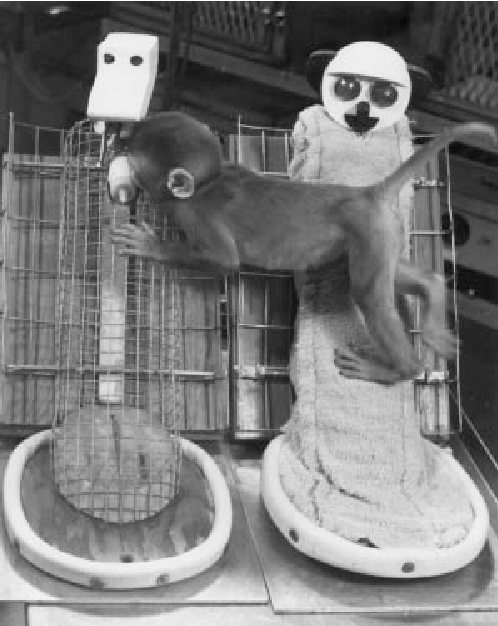
We see this most harshly in our primate relatives because of psychologist Harry Harlow. His experiments are explored in-depth in the book Love at Goon Park: Harry Harlow and the Science of Affection. His most famous experiment was with infant rhesus monkeys confined to a cage with two fake mothers. One mother was made of wire mesh and had a bottle of milk. The other mother had no milk, but was covered in soft fur.
The prevailing idea of the time was that children only needed physical sustenance from their parents to develop into healthy adults. Harlow’s experiments destroyed that idea because the young monkeys spent nearly all their time cuddling the soft mother with no milk, and briefly leaving the comforting mommy to climb on the wire mother to drink.

The visual equivalent of the effect of mental illness stigma.
A lesser known experiment by Harlow was known, by him, as The Pit of Despair. This is a truly horrific experiment.
He would take an infant from its mother at birth, and put it in an inverted triangular enclosure. The walls were sloped at an extreme angle so the monkey could never climb out. It grew up in an environment with no parenting or socialization; only food and the slow, cold realization that it could never change it’s circumstances.

This is a striking example of how a primate with no one to talk to, and no way to talk, cowers away from everything.
After a time, the monkey would be placed in an enclosure with many monkeys. They huddled in the corner, cried, and shook themselves.
Forced isolation created an animal that lived entirely in fear. Even worse, the socialized “normal” monkeys picked on the fearful monkey; increasing it’s terror and further decreasing any likelihood that it could ever socialize normally.
This is a compelling example of how badly social primates can be hurt by the inability to talk. I share these pictures because they are revolting. As the viewer, we feel such an outpouring of concern for such a sad and fearful creature.
We can feel this for a rhesus monkey in a cage, but not a human being in the cage of an ill mind. Stigma prevents us, and it prevents those suffering from seeking treatment. Lest they become a burden to those they care about.
So the young boy closes his closest door and loops a belt around his neck.
The father drives to a bridge and jumps.
The teenage girl draws a bath and slits her wrists.
All because they did not believe they could talk to anyone.
When a general returned to Rome following a victorious campaign, he paraded through the city with great pomp and circumstance.
It was customary for a slave gladiator, known as an Auriga, to whisper in the general’s ear: “Memento homo”.
Remember, you are but a man.

I suppose the modern-day corollary would be for the Golden State Warriors to hire someone to whisper in Steph Curry’s ear, “You are only a man,” while he hoists the NBA championship trophy.
It is a sobering statement in moments of victory. A reminder that we all came from dust, and to the dust we shall return. Our victories, our accolades, our possessions - nothing we do or accumulate will follow us in death, and pride, as Proverbs tells us, "goes before destruction, and a haughty spirit before a fall." While celebrating an accomplishment, it is of immense value to remember that a recent victory does not mean victory in perpetuity.
Today, though, it is fortunately impossible to forcibly compel a fellow human to give you reminders, and it is cumbersome to hire a person to stand next to you all day. However, we have devices that are always nearby and frequently checked. They can be used to remind us to think differently, to consider our choices, and to help us live the life we most want to live.

I like the quote, “Confine Yourself to the Present” by Roman Emperor Marcus Aurelius. I have it as the first section of my work binder, incorporated into my computer wallpaper, and my good friend Kevin Forrester even turned the quote into a work of art!
Having a reminder that I see multiple times a day, helps me combat my brain’s default mode of negative thinking. I can easily slip into a poor frame of mind, and it takes vigilance to keep my mind in an attitude that helps me live my life in my way.
Whether our devices are slaves to us, or are we slaves to our devices, is a question I will tackle in a different article. For now, I like taking a quote from 1,800 years ago and welding it with 21st century technology to keep me focused in a meaningful way.
If you would like a simple, and stoic wallpaper reminder for your computer or mobile device; you can download mine below.

Mobile Wallpaper

Desktop Wallpaper
Life on the 7th Shelf is my way of sharing how a person can live well with depression, anxiety, and suicidal ideation.
The 7th Shelf was written by Dante in The Inferno, as the Wood of the Suicides.
For me, living on the 7th shelf is challenging but I have found my means for winning the daily battle against the worst my mind can throw at me.
We aim to create a space of hope, filled with resources, information, tools, and more for mental health awareness and suicide prevention. We’re committed to Gordon’s vision of sharing different methods of thinking to help those with and without mental illness live more fulfilling lives.
Contact us
corsetti007@me.com


Call or text 988 for the Suicide & Crisis Lifeline for help. In an emergency, please call 911.
If you or someone you know is seeking help for mental health concerns, visit the National Alliance on Mental Health (NAMI) website, or call 1-800-950-NAMI(6264).
For confidential treatment referrals, visit the Substance Abuse and Mental Health Services Administration (SAMHSA) website, or call the National Helpline at 1-800-662-HELP(4357).